Showing posts with label science. Show all posts

20 July 2017

Researchers in Cambodia find nest of rare riverine bird

In this undated photo provided by Wildlife Conservation Society, a Masked Finfoot sits on a nest in Preah Vihear Province, Cambodia. The New York-based Wildlife Conservation Society said in a statement on Thursday, July 20, 2017 that its researchers, along with conservationists from Environment Ministry and local residents, found a nest of Masked Finfoot, along the Memay river in the Kulen Promtep Wildlife Sanctuary in Cambodia’s northern Preah Vihear Province. It said the site is the only confirmed breeding location in Cambodia for this very rare species.
Wildlife researchers in Cambodia have found a breeding location for the masked finfoot, one of the world’s most endangered birds, raising hopes of its continuing survival.

The New York-based Wildlife Conservation Society said Thursday its scientists, along with conservationists from Cambodia’s Environment Ministry and residents along the Memay river in the Kulen Promtep Wildlife Sanctuary, discovered the only confirmed breeding location in Cambodia for the very rare species.The International Union for Conservation of Nature has placed the bird on its red list of globally endangered species because its worldwide population of less than 1,000 is declining at an alarming rate. It is found only in Bangladesh, Cambodia, India, Indonesia, Laos, Malaysia, Myanmar, Singapore, Thailand and Vietnam.

12 July 2017

Scientists say massive iceberg has broken off in Antarctica

This Nov. 10, 2016 aerial photo released by NASA, shows a rift in the Antarctic Peninsula’s Larsen C ice shelf. A vast iceberg with twice the volume of Lake Erie has broken off from a key floating ice shelf in Antarctica, scientists said Wednesday July 12, 2017 . The iceberg broke off from the Larsen C ice shelf, scientists at the University of Swansea in Britain said. The iceberg, which is likely to be named A68, is described as weighing 1 trillion tons (1.12 trillion U.S. tons).
One of the biggest icebergs ever recorded, a trillion-ton behemoth more than seven times the size of New York City, has broken off of Antarctica, triggering disagreement among scientists over whether global warming is to blame.

The event, captured by satellite, happened sometime in the past few days when the giant chunk snapped off an ice shelf.

14 April 2017

Ocean world near Saturn top contender for life beyond Earth

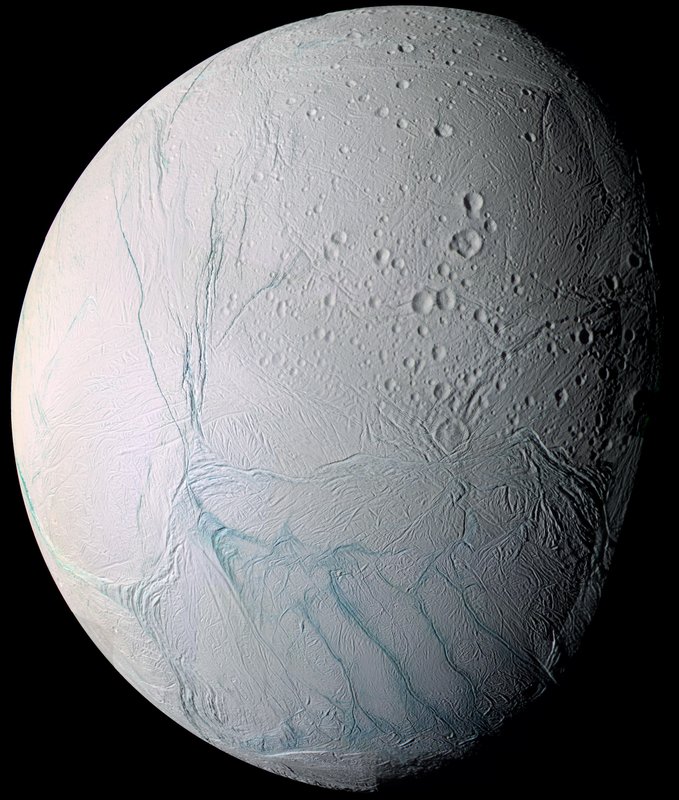
This June 28, 2009 image provided by NASA, taken by the international Cassini spacecraft, shows Enceladus, one of Saturn's moons. NASA's Cassini spacecraft has detected hydrogen molecules in the geysers shooting off the ice-encrusted ocean world, possibly the result of deep-sea chemical reactions between water and rock that could spark microbial life, according to findings announced Thursday, April 13, 2017 in the journal Science.
A tiny, ice-encrusted ocean world orbiting Saturn is now a hotter-than-ever candidate for potential life.

NASA's Cassini spacecraft has detected hydrogen molecules in the geysers shooting off the moon Enceladus, possibly the result of deep-sea chemical reactions between water and rock that could spark microbial life, scientists announced Thursday.

NASA and others are quick to point out this latest discovery does not mean there's life on Enceladus (ehn-SEHL'-uh-duhs), but that there may be conditions favorable for life.

2 March 2017

Tiny tubes in Canadian rock may be oldest known fossils

This microscope image made available by Matthew Dodd in February 2017 shows tiny tubes in rock found in Quebec, Canada. The structures appear to be the oldest known fossils, giving new support to some ideas about how life began, a new study says.
Tiny tubes and filaments in some Canadian rock appear to be the oldest known fossils, giving new support to some ideas about how life began, a new study says.

The features are mineralized remains of what appear to be bacteria that lived some 3.77 billion to 4.28 billion years ago, the scientists said. That would surpass the 3.7 billion years assigned to some other rock features found in Greenland, which were proposed to be fossils last August.

23 February 2017

7 Earth-size worlds found orbiting star; could hold life

This image provided by NASA/JPL-Caltech shows an artist's conception of what the surface of the exoplanet TRAPPIST-1f may look like, based on available data about its diameter, mass and distances from the host star. The planets circle tightly around a dim dwarf star called Trappist-1, barely the size of Jupiter. Three are in the so-called habitable zone, where liquid water and, possibly life, might exist. The others are right on the doorstep.
For the first time, astronomers have discovered seven Earth-size planets orbiting a single nearby star — and these new worlds could hold life.
This cluster of planets is less than 40 light-years away in the constellation Aquarius, according to NASA and the Belgian-led research team who announced the discovery Wednesday.

4 February 2017

The cave squeaker returns: Rare frog seen after decades

In this Dec. 3, 2016 photo, a man holds a rare frog that hasn't been seen in decades, in Bulawayo, Zimbabwe. The Artholeptis troglodytes, also known as the “cave squeaker” because of its preferred habitat, was discovered in 1962 but there were no reported sightings of the elusive amphibian after that. An international “red list” of threatened species tagged them as critically endangered and possibly extinct.
The cave squeaker is back.

Researchers in Zimbabwe say they have found a rare frog that hasn't been seen in decades.
The Artholeptis troglodytes, also known as the "cave squeaker" because of its preferred habitat, was discovered in 1962 but there were no reported sightings of the elusive amphibian after that. An international "red list" of threatened species tagged them as critically endangered and possibly extinct.

12 January 2017

Scientists: Moon over the hill at 4.51 billion years old

In this Feb. 13, 1971 file photo, Apollo 14 astronaut Alan B. Shepard Jr. conducts an experiment near a lunar crater, using an instrument from a two-wheeled cart carrying various tools. On Wednesday, Jan. 11, 2017, a California-led research team reported that the moon formed within 60 million years of the birth of the solar system. Previous estimates ranged within 100 million years, all the way out to 200 million years of the solar system’s creation.
It turns out the moon is older than many scientists suspected: a ripe 4.51 billion years old.
That's the newest estimate, thanks to rocks and soil collected by the Apollo 14 moonwalkers in 1971.
A research team reported Wednesday that the moon formed within 60 million years of the birth of the solar system. Previous estimates ranged within 100 million years, all the way out to 200 million years after the solar system's creation, not quite 4.6 billion years ago.

27 December 2016

Vera Rubin, who did pioneering work on dark matter, dies

In this image taken in the 1970s and provided by the Carnegie Institution of Washington, Vera Rubin uses a measuring engine. Rubin, a pioneering astronomer who helped find powerful evidence of dark matter died Sunday, Dec. 25, 2016. She was 88.
Vera Rubin, a pioneering astronomer who helped find powerful evidence of dark matter, has died, her son said Monday.

She was 88.
Allan Rubin, a professor of geosciences at Princeton University, said his mother died Sunday night of natural causes. He said the Philadelphia native had been living in the Princeton area.
Vera Rubin found that galaxies don't quite rotate the way they were predicted, and that lent support to the theory that some other force was at work, namely dark matter.