Showing posts with label Science and Technology. Show all posts

14 April 2017

Ocean world near Saturn top contender for life beyond Earth

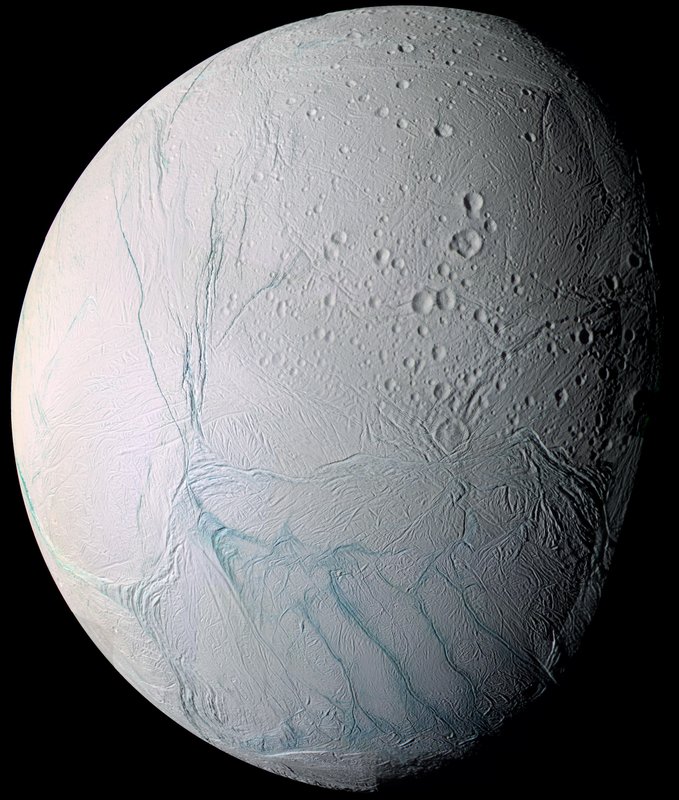
This June 28, 2009 image provided by NASA, taken by the international Cassini spacecraft, shows Enceladus, one of Saturn's moons. NASA's Cassini spacecraft has detected hydrogen molecules in the geysers shooting off the ice-encrusted ocean world, possibly the result of deep-sea chemical reactions between water and rock that could spark microbial life, according to findings announced Thursday, April 13, 2017 in the journal Science.
A tiny, ice-encrusted ocean world orbiting Saturn is now a hotter-than-ever candidate for potential life.

NASA's Cassini spacecraft has detected hydrogen molecules in the geysers shooting off the moon Enceladus, possibly the result of deep-sea chemical reactions between water and rock that could spark microbial life, scientists announced Thursday.

NASA and others are quick to point out this latest discovery does not mean there's life on Enceladus (ehn-SEHL'-uh-duhs), but that there may be conditions favorable for life.

2 March 2017

Tiny tubes in Canadian rock may be oldest known fossils

This microscope image made available by Matthew Dodd in February 2017 shows tiny tubes in rock found in Quebec, Canada. The structures appear to be the oldest known fossils, giving new support to some ideas about how life began, a new study says.
Tiny tubes and filaments in some Canadian rock appear to be the oldest known fossils, giving new support to some ideas about how life began, a new study says.

The features are mineralized remains of what appear to be bacteria that lived some 3.77 billion to 4.28 billion years ago, the scientists said. That would surpass the 3.7 billion years assigned to some other rock features found in Greenland, which were proposed to be fossils last August.

12 January 2017

Scientists: Moon over the hill at 4.51 billion years old

In this Feb. 13, 1971 file photo, Apollo 14 astronaut Alan B. Shepard Jr. conducts an experiment near a lunar crater, using an instrument from a two-wheeled cart carrying various tools. On Wednesday, Jan. 11, 2017, a California-led research team reported that the moon formed within 60 million years of the birth of the solar system. Previous estimates ranged within 100 million years, all the way out to 200 million years of the solar system’s creation.
It turns out the moon is older than many scientists suspected: a ripe 4.51 billion years old.
That's the newest estimate, thanks to rocks and soil collected by the Apollo 14 moonwalkers in 1971.
A research team reported Wednesday that the moon formed within 60 million years of the birth of the solar system. Previous estimates ranged within 100 million years, all the way out to 200 million years after the solar system's creation, not quite 4.6 billion years ago.

28 September 2016

Baby born with DNA from 3 people, first from new technique

Scientists say the first baby has been born from a controversial new technique that combines DNA from three people — the mother, the father and an egg donor.
The goal was to prevent the child from inheriting a fatal genetic disease from his mother, who had previously lost two children to the illness.
The birth of the boy is revealed in a research summary published by the journal Fertility & Sterility. Scientists are scheduled to present details at a meeting next month in Salt Lake City.

25 September 2016

China begins operating world's largest radio telescope

In this Saturday, Sept. 24, 2016 photo released by Xinhua News Agency, an aerial view shows the Five-hundred-meter Aperture Spherical Telescope (FAST) in the remote Pingtang county in southwest China's Guizhou province. China has begun operating the world's largest radio telescope to help search for extraterrestrial life.
The world's largest radio telescope began searching for signals from stars and galaxies and, perhaps, extraterrestrial life Sunday in a project demonstrating China's rising ambitions in space and its pursuit of international scientific prestige.
Beijing has poured billions into such ambitious scientific projects as well as its military-backed space program, which saw the launch of China's second space station earlier this month.

15 March 2016

European, Russian space agencies launch mission to Mars

The Proton-M rocket booster blasts off at the Russian leased Baikonur cosmodrome, Kazakhstan, Monday, March 14, 2016. Europe and Russia launched a joint mission Monday to explore the atmosphere of Mars and hunt for signs of life on the red planet. The unmanned ExoMars probe, a collaboration between the European Space Agency and Roscosmos, took off aboard a Russian rocket and is expected to reach Mars in October.
Europe and Russia launched a joint mission Monday to explore the atmosphere of Mars and hunt for signs of life on the red planet.

The unmanned ExoMars probe— a collaboration between the European Space Agency and Roscosmos — took off from a base in Kazakhstan aboard a Russian rocket.