Showing posts with label solar system. Show all posts

14 April 2017

Ocean world near Saturn top contender for life beyond Earth

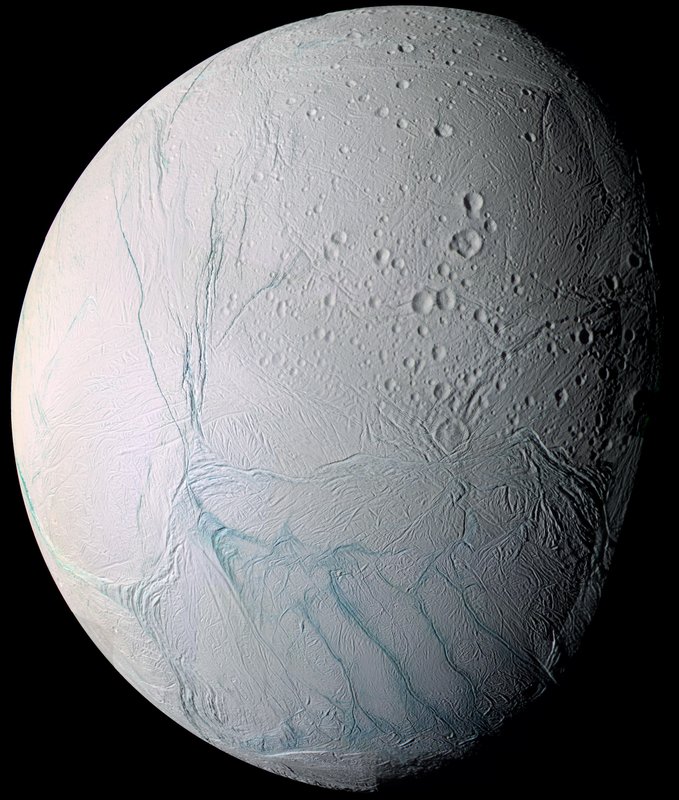
This June 28, 2009 image provided by NASA, taken by the international Cassini spacecraft, shows Enceladus, one of Saturn's moons. NASA's Cassini spacecraft has detected hydrogen molecules in the geysers shooting off the ice-encrusted ocean world, possibly the result of deep-sea chemical reactions between water and rock that could spark microbial life, according to findings announced Thursday, April 13, 2017 in the journal Science.
A tiny, ice-encrusted ocean world orbiting Saturn is now a hotter-than-ever candidate for potential life.

NASA's Cassini spacecraft has detected hydrogen molecules in the geysers shooting off the moon Enceladus, possibly the result of deep-sea chemical reactions between water and rock that could spark microbial life, scientists announced Thursday.

NASA and others are quick to point out this latest discovery does not mean there's life on Enceladus (ehn-SEHL'-uh-duhs), but that there may be conditions favorable for life.

23 February 2017

7 Earth-size worlds found orbiting star; could hold life

This image provided by NASA/JPL-Caltech shows an artist's conception of what the surface of the exoplanet TRAPPIST-1f may look like, based on available data about its diameter, mass and distances from the host star. The planets circle tightly around a dim dwarf star called Trappist-1, barely the size of Jupiter. Three are in the so-called habitable zone, where liquid water and, possibly life, might exist. The others are right on the doorstep.
For the first time, astronomers have discovered seven Earth-size planets orbiting a single nearby star — and these new worlds could hold life.
This cluster of planets is less than 40 light-years away in the constellation Aquarius, according to NASA and the Belgian-led research team who announced the discovery Wednesday.

12 January 2017

Scientists: Moon over the hill at 4.51 billion years old

In this Feb. 13, 1971 file photo, Apollo 14 astronaut Alan B. Shepard Jr. conducts an experiment near a lunar crater, using an instrument from a two-wheeled cart carrying various tools. On Wednesday, Jan. 11, 2017, a California-led research team reported that the moon formed within 60 million years of the birth of the solar system. Previous estimates ranged within 100 million years, all the way out to 200 million years of the solar system’s creation.
It turns out the moon is older than many scientists suspected: a ripe 4.51 billion years old.
That's the newest estimate, thanks to rocks and soil collected by the Apollo 14 moonwalkers in 1971.
A research team reported Wednesday that the moon formed within 60 million years of the birth of the solar system. Previous estimates ranged within 100 million years, all the way out to 200 million years after the solar system's creation, not quite 4.6 billion years ago.

21 January 2016

New evidence points to giant 9th planet on solar system edge

This artistic rendering provided by California Institute of Technology shows the distant view from Planet Nine back towards the sun. The planet is thought to be gaseous, similar to Uranus and Neptune. Hypothetical lightning lights up the night side. Scientists reported Wednesday, Jan. 20, 2016, they finally have "good evidence" for Planet X, a true ninth planet on the fringes of our solar system.
The solar system may have a ninth planet after all.

This one is 5,000 times bigger than outcast Pluto and billions of miles farther away, say scientists who presented "good evidence" for a long-hypothesized Planet X on Wednesday.
The gas giant is thought to be almost as big as its nearest planetary neighbor Neptune, quite possibly with rings and moons. It's so distant that it would take a mind-blowing 10,000 to 20,000 years to circle the sun.