Showing posts with label NASA. Show all posts

14 April 2017

Ocean world near Saturn top contender for life beyond Earth

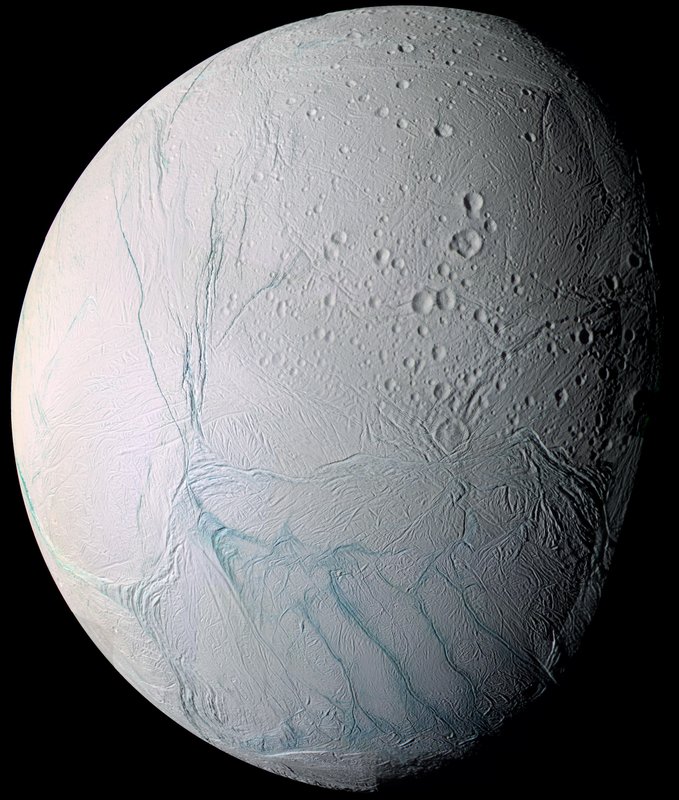
This June 28, 2009 image provided by NASA, taken by the international Cassini spacecraft, shows Enceladus, one of Saturn's moons. NASA's Cassini spacecraft has detected hydrogen molecules in the geysers shooting off the ice-encrusted ocean world, possibly the result of deep-sea chemical reactions between water and rock that could spark microbial life, according to findings announced Thursday, April 13, 2017 in the journal Science.
A tiny, ice-encrusted ocean world orbiting Saturn is now a hotter-than-ever candidate for potential life.

NASA's Cassini spacecraft has detected hydrogen molecules in the geysers shooting off the moon Enceladus, possibly the result of deep-sea chemical reactions between water and rock that could spark microbial life, scientists announced Thursday.

NASA and others are quick to point out this latest discovery does not mean there's life on Enceladus (ehn-SEHL'-uh-duhs), but that there may be conditions favorable for life.

23 February 2017

7 Earth-size worlds found orbiting star; could hold life

This image provided by NASA/JPL-Caltech shows an artist's conception of what the surface of the exoplanet TRAPPIST-1f may look like, based on available data about its diameter, mass and distances from the host star. The planets circle tightly around a dim dwarf star called Trappist-1, barely the size of Jupiter. Three are in the so-called habitable zone, where liquid water and, possibly life, might exist. The others are right on the doorstep.
For the first time, astronomers have discovered seven Earth-size planets orbiting a single nearby star — and these new worlds could hold life.
This cluster of planets is less than 40 light-years away in the constellation Aquarius, according to NASA and the Belgian-led research team who announced the discovery Wednesday.

17 January 2017

Gene Cernan, last astronaut to walk on the moon, dies at 82

In a Oct. 27, 2007 file photo, former astronaut Neil Armstrong, left, is congratulated by fellow ex-astronaut Gene Cernan following the dedication ceremony of the Neil Armstrong Hall of Engineering at Purdue University in West Lafayette, Ind. NASA announced that former astronaut Gene Cernan, the last man to walk on the moon, died Monday, Jan. 16, 2017, surrounded by his family. He was 82.
Former astronaut Gene Cernan, who as the last person to walk on the moon returned to Earth with a message of "peace and hope for all mankind," died on Monday, his family said. He was 82.
Cernan was with his relatives when he died at a Houston hospital following ongoing heath issues, family spokeswoman Melissa Wren told The Associated Press. His family said his devotion to lunar exploration never waned.
"Even at the age of 82, Gene was passionate about sharing his desire to see the continued human exploration of space and encouraged our nation's leaders and young people to not let him remain the last man to walk on the Moon," his family said in a statement released by NASA.

6 February 2016

Astronaut Edgar Mitchell, 6th man on moon, dies in Florida

In a Sept. 5, 2007 file photo, former astronaut Edgar Mitchell arrives for the premiere of the "In the Shadow of the Moon," at the Hayden Planetarium at the Museum of Natural History in New York. Apollo 14 astronaut Mitchell, who became the sixth man on the moon when he and Alan Shepard helped NASA recover from Apollo 13's "successful failure" and later devoted his life to exploring the mind, physics and unexplained phenomena such as psychics and aliens, died Thursday, Feb. 4, 2016, at a West Palm Beach, Florida, hospice after a short illness. He was 85.
Apollo 14 astronaut Edgar Mitchell, who became the sixth man on the moon when he and Alan Shepard helped NASA recover from Apollo 13's "successful failure" and later devoted his life to exploring physics, the mind, and unexplained phenomena such as psychics and aliens, has died in Florida. He was 85.
Mitchell died Thursday night at a West Palm Beach hospice after a short illness, his daughter, Kimberly Mitchell, said. Mitchell's passing coincides with the 45th anniversary of the Apollo 14 mission from Jan. 31-Feb. 9, 1971.

29 September 2015

Life on Mars? NASA says planet appears to have flowing water

This undated photo provided by NASA and taken by an instrument aboard the agency's Mars Reconnaissance Orbiter shows dark, narrow, 100 meter-long streaks on the surface of Mars that scientists believe were caused by flowing streams of salty water. Researchers said Monday, Sept. 28, 2015, that the latest observations strongly support the longtime theory that salt water in liquid form flows down certain Martian slopes each summer.
Mars appears to have flowing rivulets of water, at least in the summer, scientists reported Monday in a finding that boosts the odds of life on the red planet.

"Mars is not the dry, arid planet that we thought of in the past," said Jim Green, director of planetary science for NASA.