Showing posts with label astronomy. Show all posts

14 April 2017

Ocean world near Saturn top contender for life beyond Earth

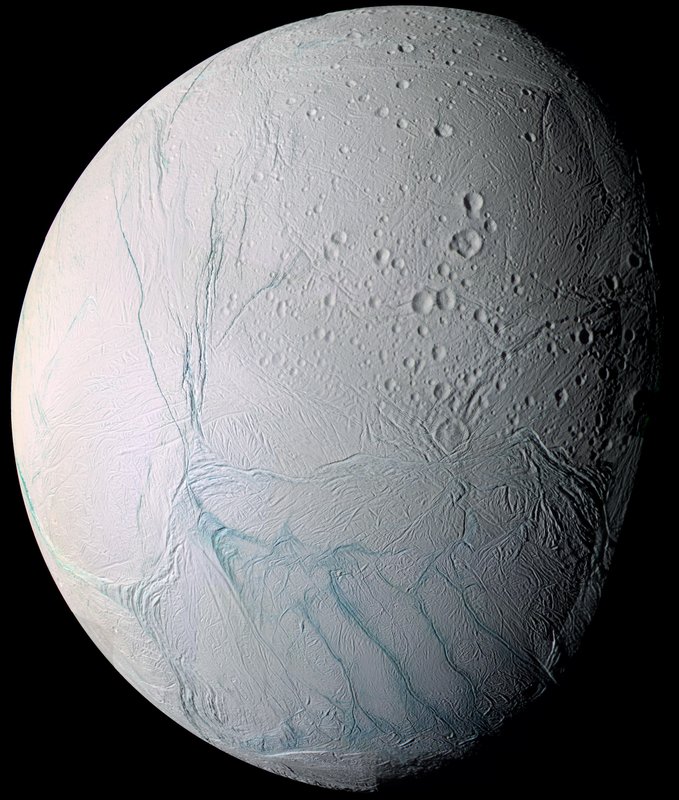
This June 28, 2009 image provided by NASA, taken by the international Cassini spacecraft, shows Enceladus, one of Saturn's moons. NASA's Cassini spacecraft has detected hydrogen molecules in the geysers shooting off the ice-encrusted ocean world, possibly the result of deep-sea chemical reactions between water and rock that could spark microbial life, according to findings announced Thursday, April 13, 2017 in the journal Science.
A tiny, ice-encrusted ocean world orbiting Saturn is now a hotter-than-ever candidate for potential life.

NASA's Cassini spacecraft has detected hydrogen molecules in the geysers shooting off the moon Enceladus, possibly the result of deep-sea chemical reactions between water and rock that could spark microbial life, scientists announced Thursday.

NASA and others are quick to point out this latest discovery does not mean there's life on Enceladus (ehn-SEHL'-uh-duhs), but that there may be conditions favorable for life.

23 February 2017

7 Earth-size worlds found orbiting star; could hold life

This image provided by NASA/JPL-Caltech shows an artist's conception of what the surface of the exoplanet TRAPPIST-1f may look like, based on available data about its diameter, mass and distances from the host star. The planets circle tightly around a dim dwarf star called Trappist-1, barely the size of Jupiter. Three are in the so-called habitable zone, where liquid water and, possibly life, might exist. The others are right on the doorstep.
For the first time, astronomers have discovered seven Earth-size planets orbiting a single nearby star — and these new worlds could hold life.
This cluster of planets is less than 40 light-years away in the constellation Aquarius, according to NASA and the Belgian-led research team who announced the discovery Wednesday.

27 December 2016

Vera Rubin, who did pioneering work on dark matter, dies

In this image taken in the 1970s and provided by the Carnegie Institution of Washington, Vera Rubin uses a measuring engine. Rubin, a pioneering astronomer who helped find powerful evidence of dark matter died Sunday, Dec. 25, 2016. She was 88.
Vera Rubin, a pioneering astronomer who helped find powerful evidence of dark matter, has died, her son said Monday.

She was 88.
Allan Rubin, a professor of geosciences at Princeton University, said his mother died Sunday night of natural causes. He said the Philadelphia native had been living in the Princeton area.
Vera Rubin found that galaxies don't quite rotate the way they were predicted, and that lent support to the theory that some other force was at work, namely dark matter.

25 September 2016

China begins operating world's largest radio telescope

In this Saturday, Sept. 24, 2016 photo released by Xinhua News Agency, an aerial view shows the Five-hundred-meter Aperture Spherical Telescope (FAST) in the remote Pingtang county in southwest China's Guizhou province. China has begun operating the world's largest radio telescope to help search for extraterrestrial life.
The world's largest radio telescope began searching for signals from stars and galaxies and, perhaps, extraterrestrial life Sunday in a project demonstrating China's rising ambitions in space and its pursuit of international scientific prestige.
Beijing has poured billions into such ambitious scientific projects as well as its military-backed space program, which saw the launch of China's second space station earlier this month.

9 May 2016

Little Mercury a black dot as it crosses vast face of sun

The transit of Mercury, left, in front of the Sun is seen from St.Petersburg, Russia, Monday, May 9, 2016. The photo was taken through a hydrogen-alpha (H-alpha) narrow spectrum solar telescope that permits examination of the sun's protuberances and showing the surface activity.
For the first time in 10 years, Mercury passed directly between the Earth and sun on Monday, resembling a black dot against the vast, glowing face of our star.
Many stargazers turned to the Internet as NASA provided close-to-real-time images of the 7½-hour trek, courtesy of the Solar Dynamics Observatory.
Although the solar system's small, innermost planet appeared to be trudging along, it actually was zooming past the sun at 106,000 mph.