Showing posts with label Climate change. Show all posts

2 September 2017

A singular storm in Houston; a recurring nightmare in Mumbai

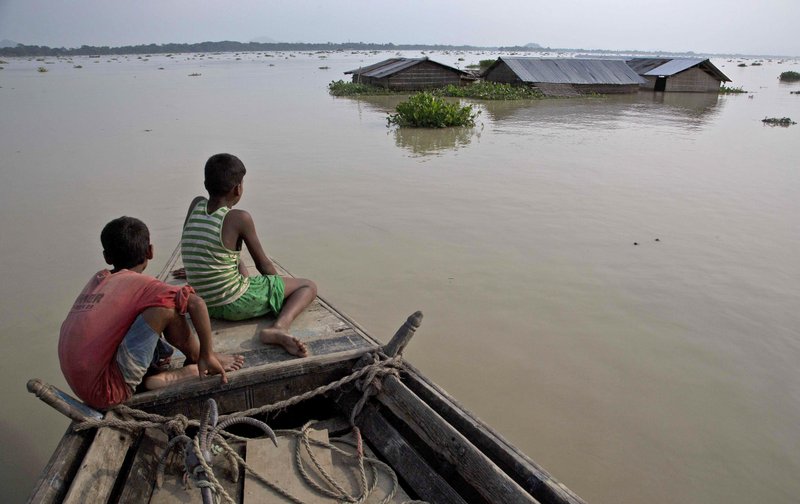
In this Aug. 15, 2017, file photo, flood affected villagers travel by boat in floodwaters in Morigaon district, east of Gauhati, northeastern state of Assam. This week’s flooding in Houston is unprecedented, but such devastation is chronic across South Asia. Experts say local officials are ignoring dangers and pursuing development plans that only increase the risk of flood-related death and destruction as annual monsoon rains challenge cities to cope.
Two massive, rain-soaked cities on opposite sides of the world are struggling with swirling, brackish waters that have brought death and devastation. For Houston, it’s unprecedented. For Mumbai, it’s painfully common.

For India’s financial capital and other South Asian cities and farmlands, floods are regular, cataclysmic occurrences made worse by breakneck urban development and population booms that will only become more challenging as climate change increases disaster risk.

12 July 2017

Scientists say massive iceberg has broken off in Antarctica

This Nov. 10, 2016 aerial photo released by NASA, shows a rift in the Antarctic Peninsula’s Larsen C ice shelf. A vast iceberg with twice the volume of Lake Erie has broken off from a key floating ice shelf in Antarctica, scientists said Wednesday July 12, 2017 . The iceberg broke off from the Larsen C ice shelf, scientists at the University of Swansea in Britain said. The iceberg, which is likely to be named A68, is described as weighing 1 trillion tons (1.12 trillion U.S. tons).
One of the biggest icebergs ever recorded, a trillion-ton behemoth more than seven times the size of New York City, has broken off of Antarctica, triggering disagreement among scientists over whether global warming is to blame.

The event, captured by satellite, happened sometime in the past few days when the giant chunk snapped off an ice shelf.

9 July 2017

G-20 shut Trump out on climate, strike deal on trade

Leaders, including German Chancellor Angela Merkel, left, and their partners attend a concert at the Elbphilharmonie concert hall on the first day of the G-20 summit in Hamburg, northern Germany, Friday, July 7, 2017.
World powers lined up against U.S. President Donald Trump on climate change, reaffirming their support for international efforts to fight global warming.

The Group of 20 summit that ended Saturday in Hamburg also revealed tensions on trade, as the U.S. administration and international partners forged a deal that endorsed open markets but acknowledged countries had a right to put up barriers to block unfair practices.

8 July 2017

Key points from the G20 summit of world leaders

Japanese Prime Minister Shinzo Abe, left to right, World Bank President Jim Yong Kim, United States President Donald Trump, his daughter Ivanka Trump, German Chancellor Angela Merkel and Prime Minister Justin Trudeau pose for a photo after the Women and Development event at the G20 summit Saturday, July 8, 2017 in Hamburg, Germany.
Leaders of the Group of 20 rich and developing countries spent two days trying to come up with common positions on climate change, trade and migration at their summit in Hamburg, Germany.

Implementation depends on the will of national governments to take action, and compliance isn’t perfect. But a common statement of purpose sets the tone for policy and enables peer pressure.

Here’s a look at what the leaders did — and didn’t — agree on:

25 September 2016

India to ratify Paris Agreement on climate change

In this Nov. 30, 2015 file photo, India's Prime Minister Narendra Modi addresses world leaders at the COP21, United Nations Climate Change Conference, in Le Bourget, outside Paris. India's leader says his country will ratify the Paris Agreement on climate change early next month. Modi said Sunday that his government will ratify the agreement Oct. 2, coinciding with the birth anniversary of India's independence leader Mohandas Gandhi.
India's prime minister said Sunday that his country will ratify the Paris Agreement on climate change early next month.
Prime Minister Narendra Modi said his government will ratify the agreement Oct. 2, coinciding with the birth anniversary of India's independence leader Mohandas Gandhi, who believed in a minimum carbon footprint. Modi made the announcement at a meeting of his Bharatiya Janata Party's leaders in the southern Indian town of Kozhikode.

8 June 2016

Obama meets Indian PM, seeks implementation of climate pact

In this Jan. 25, 2015 file photo, U.S. President Barack Obama, left, and Indian Prime Minister Narendra Modi prepare to shake their hands after they jointly addressed the media in New Delhi, India. On Monday June 7 2016 Modi arrived in Washington during a five-nation tour that also takes him to Switzerland, Afghanistan, Mexico and Qatar. He meets with Obama on Tuesday, and addresses a joint meeting of Congress on Wednesday. He’ll also meet Congressional leaders and top business officials.
India will try to join a climate change deal within this year, the Obama administration said Tuesday, as Prime Minister Narendra Modi met President Barack Obama at the White House and the two leaders played up their efforts to cooperate on issues of global concern.
Stressing their "strong bonds," Obama said the world's two largest democracies had "joined forces" to bring about the landmark climate agreement that was reached in Paris last December.

13 December 2015

Historic pact to slow global warming is celebrated in Paris

The slogan "CLIMATESIGN" is projected on the Eiffel Tower as part of the COP21, United Nations Climate Change Conference in Paris, France, Friday, Dec. 11, 2015.
Nearly 200 nations adopted the first global pact to fight climate change on Saturday, calling on the world to collectively cut and then eliminate greenhouse gas pollution but imposing no sanctions on countries that don't.
The "Paris agreement" aims to keep global temperatures from rising another degree Celsius (1.8 Fahrenheit) between now and 2100, a key demand of poor countries ravaged by rising sea levels and other effects of climate change.

30 November 2015

Timeline of key events in UN effort against climate change

The flags of the U.N. and France fly as world leaders arrive for the COP21, United Nations Climate Change Conference, in Le Bourget, outside Paris, Monday, Nov. 30, 2015.
After decades of warnings from scientists that greenhouse gas emissions were warming the planet, governments started coming together in the 1980s to combat the problem. Here's a timeline of key moments in the diplomatic effort to stop global warming, leading up to the U.N. climate conference in Paris:
1987: MONTREAL — Governments adopt a treaty pledging to restrict emissions of chemicals damaging the ozone layer. While it doesn't deal with climate change specifically, the Montreal Protocol becomes a model for how to rein in man-made emissions through international agreements.

29 November 2015

Commonwealth seeks legally binding climate deal in Paris

From left, Prime Minister of Barbados Freundel Stuart, President of Ghana John Dramani Mahama, Commonwealth Secretary General Kamalesh Sharma, Malta's Prime Minister Joseph Muscat, President of Kenya Uhuru Kenyatta and President of Nauru Baron Divavesi Waqa attend a press conference at conclusion of the Commonwealth Heads of Governments meeting in Ghajn Tuffieha, Malta, Saturday, 29 Nov. 2015.
The 53-nation Commonwealth has said climate change poses an "existential threat" to some of its member states, and urged participants at the Paris climate talks to produce a legally binding agreement on cutting greenhouse gas emissions.
The Commonwealth — a grouping of Britain and many of its former colonies that is home to more than 2 billion people — includes industrialized economies such as Canada and Australia, resource-hungry India and small island states vulnerable to rising sea levels.

Energy-rich Russia pays little attention to climate change

Trees are cut along a construction site of a new highway in Moscow region in this Tuesday, Nov. 17, 2015 photo. As the climate warms, moisture levels are changing with wet areas becoming wetter and dry areas drier. Russia is the fastest warming part of the world, according to a report from the country’s weather monitoring agency. The steady rise in temperatures puts Siberia- known for its long winters and lush forests- at risk to natural disasters, such forest fires.
When forest fires roared through Siberia this summer, so vast that the smoke blocked vast Lake Baikal from satellite view, Russian officials blamed the blazes on arsonists and disorganized fire crews. Environmentalists say there was another culprit: global warming.
As temperatures rise worldwide, areas such as Siberia are suffering increasingly long dry spells. Russia's national weather agency says the country is the fastest-warming part of the world.

25 November 2015

UN weather agency: It's record hot out there this year

In this May 31, 2015 file photo, an Indian man rests in front of an air cooler to cool himself on a hot summer day in Hyderabad, in the southern Indian state of Telangana. Because of man-made global warming and a strong El Nino, Earth’s wild weather this year is bursting the annual heat record, the World Meteorological Organization announced Wednesday.
Because of man-made global warming and a strong El Nino, Earth's wild weather this year is bursting the annual heat record, the World Meteorological Organization announced on Wednesday.
The United Nations weather agency's early bird report on 2015 says it is the hottest year on record, surpassing last year's record heat. It made the proclamation without waiting for the end of the year because it has been so extraordinarily hot, forecast to stay that way and unlikely to cool down enough to not set a record.

9 November 2015

World Bank: Climate change could result in 100 million poor

In this file photo dated Thursday, April 23, 2015, an Indian worker dismantles an old car amid heaps of scrap in Bangalore, India. Climate change could push more than 100 million people into extreme poverty by 2030 by disrupting agriculture and fueling the spread of malaria and other diseases, the World Bank said in a report Sunday Nov. 8, 2015. Carbon emissions are expected to rise for many years as China, India and other developing countries expand the use of fossil fuels to power their economies.
Climate change could push more than 100 million people into extreme poverty by 2030 by disrupting agriculture and fueling the spread of malaria and other diseases, the World Bank said in a report Sunday.
Released just weeks ahead of a U.N. climate summit in Paris, the report highlighted how the impact of global warming is borne unevenly, with the world's poor woefully unprepared to deal with climate shocks such as rising seas or severe droughts.