Showing posts with label spy. Show all posts

23 June 2018

Ex-S. Korean premier Kim Jong-pil, spy agency founder, dies

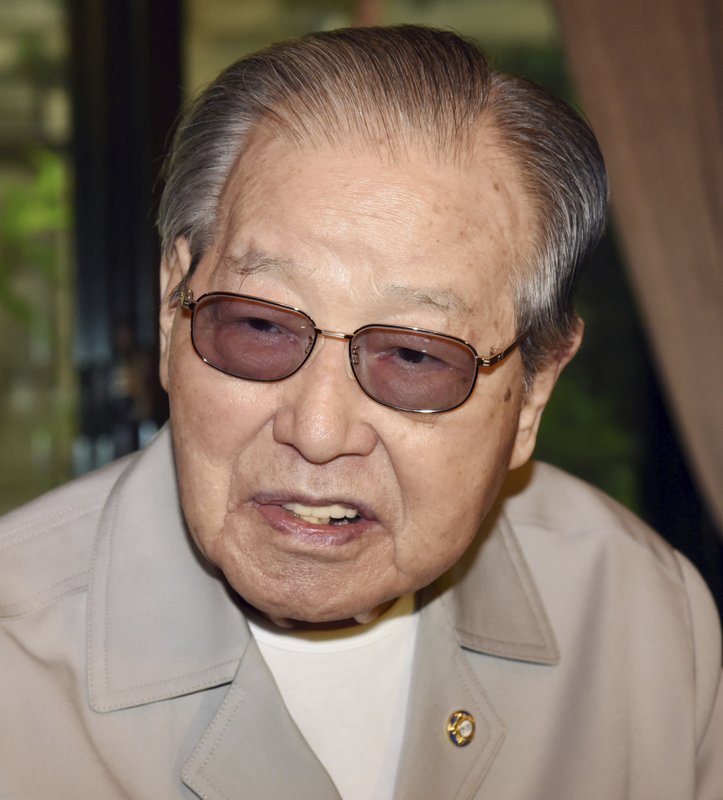
In this Aug.19, 2016, photo, Kim Jong-pil, the founder of South Korea’s spy agency who also served twice as prime minister, first under his dictator boss and later under a man his agency kidnapped, talks with South Korean lawmakers at his house in Seoul, South Korea. Kim has died on Saturday, June 23, 2018 at the age of 92.
Kim Jong-pil, the founder of South Korea’s spy agency whose political skills helped him also serve twice as prime minister, first under his dictator boss and later under a man his agency kidnapped, has died. He was 92.

Kim was declared dead on arrival at Seoul’s Soonchunhyang University Hospital from his home on Saturday, said hospital official Lee Mi-jong. He described the cause of death as age-related complications.

South Korea’s presidential office released a statement saying Kim’s “fingerprints and footprints that marked South Korea’s modern political history will not be easily erased.”
18 May 2017

UN court orders Pakistan not to execute Indian national

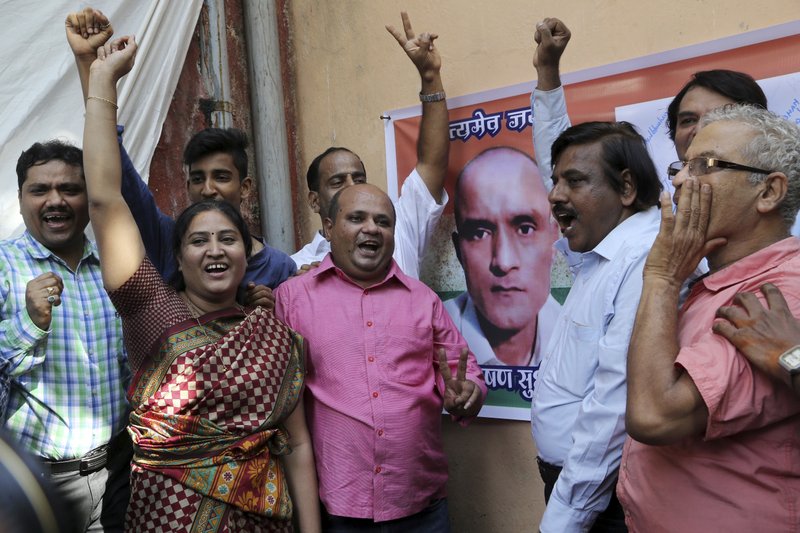
Friends of Indian naval officer Kulbhushan Jadhav celebrate the International Court of Justice order on Jadhav as they gather near a portrait of him in Mumbai, India, Thursday, May 18, 2017. The U.N. court on Thursday ordered Pakistan not to execute the Indian naval officer convicted of espionage and terrorism, in a case that has further strained relations between the Asian neighbors.
The International Court of Justice on Thursday ordered Pakistan not to execute an Indian naval officer convicted of espionage and terrorism, a case that has further strained relations between the Asian neighbors.

The officer, Kulbhushan Jadhav, was convicted in Pakistan and sentenced to death on April 10. The U.N. court ruled unanimously that Pakistan shouldn’t put Jadhav to death until India’s allegation that Pakistan breached his right to consular assistance is legally resolved.

10 April 2017

Pakistan's army sentences alleged Indian spy to death

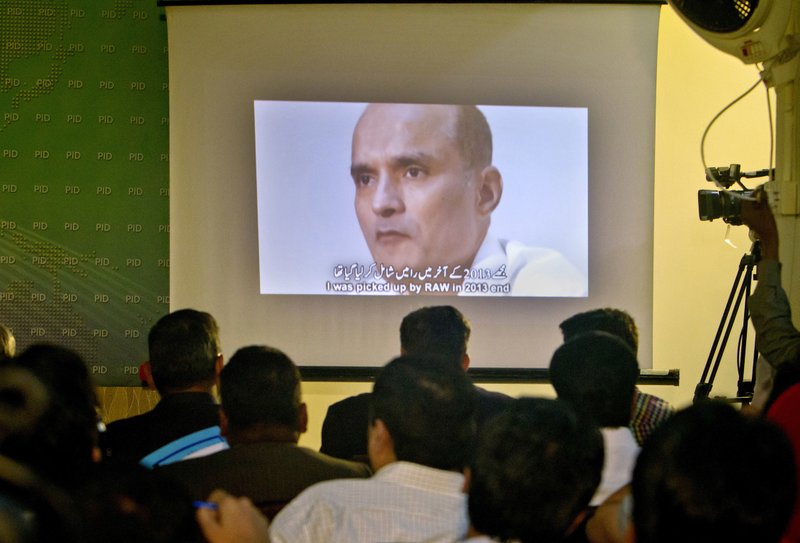
In this March 29, 2016 photo, journalists look a image of Indian naval officer Kulbhushan Jadhav, who was arrested in March 2016, during a press conference by Pakistan's army spokesman and the Information Minister, in Islamabad, Pakistan. The army said in a statement Monday, April 10, 2017, that Jadhav was sentenced to death on charges of espionage and sabotage. Pakistan says Jadhav was an Indian intelligence official who aided and financed terrorist activities.
Pakistan's military sentenced an Indian naval officer to death Monday on charges of espionage and sabotage, officials said.

Kulbhushan Jadhav, who was arrested in March 2016, had been convicted by a military tribunal, the Pakistani army said in a statement. Gen. Qamar Javed Bajwa, the head of Pakistan's armed forces, signed off on the sentence.

Pakistan's Defense Minister Khawaja Mohammad Asif alleged that the spy had official Indian government backing.

24 February 2017

Report: German spy agency targets foreign reporters' phones

The July 8, 2013 file picture shows the BND monitoring base in Bad Aibling, near Munich, Germany. German weekly Der Spiegel reported Friday, Feb. 24, 2017 that the country's spy agency had at least 50 numbers and email addresses belonging to journalists among its targets for surveillance
The German weekly Der Spiegel reports that the country's spy agency had at least 50 numbers and email addresses of journalists among its surveillance targets.

Spiegel reported Friday that a list seen by the magazine contained over a dozen numbers belonging to the BBC in Afghanistan and London. It says a New York Times phone number in Afghanistan and several cell and satellite phone numbers for the Reuters news agency in Afghanistan, Pakistan and Nigeria were also on the list.

22 January 2016

What We Know: Key takeaways in case of poisoned spy

Russian President Vladimir Putin, left, and President's aide Andrei Fursenko attend a meeting of the presidential education council in the Kremlin in Moscow, Thursday, Jan. 21, 2016. Putin probably approved a plan by Russia's FSB security service to kill a former agent turned Kremlin critic Alexander Litvinenko who died after drinking tea laced with radioactive poison, a British judge said on Thursday in a report that led Moscow to accuse Britain of souring bilateral relations.
A British judge has concluded that two Russians, acting at the behest of Moscow's security services and probably with approval from President Vladimir Putin, poisoned ex-KGB agent and fierce Kremlin critic Alexander Litvinenko. Here's what we know:

21 January 2016

Timeline of events in Alexander Litvinenko investigation

Alex Goldfarb, friend of former Russian spy Alexander Litvinenko, looks at the report, during a press conference with Marina Litvinenko, widow of Litvinenko, in London, Thursday, Jan. 21, 2016. Judge Robert Owen said Thursday he is certain that Litvinenko was given tea laced with a fatal dose of polonium-210 at a London hotel in November 2006. He says there is a "strong probability" that the FSB directed the killing and the operation was "probably approved" by Russian President Vladimir Putin.
A British judge has published a report on the 2006 death of former Russian agent Alexander Litvinenko, saying President Vladimir Putin probably approved a plan by the Russian security service to kill him with poison. Here is a timeline of events surrounding the case:
— 2000: Litvinenko flees Russia and seeks political asylum in Britain, which was granted the following year.

7 July 2014

Soviet defector's trove of KGB secrets made public

This undated image made available by the Churchill Archive Centre shows Vasili Mitrokhin's handwritten copy of the KGB First Chief Directorate Lexicon. Original documents from one of the biggest intelligence leaks in history - a who's who of Soviet spying - were released Monday, July 7, 2014, after being held in secret for two decades. The files smuggled out of Russia in 1992 by senior KGB official Vasili Mitrokhin describe sabotage plots, booby-trapped weapons caches and armies of agents under cover in the West - the real-life inspiration for the fictional Soviet moles in TV series "The Americans."
The papers spent years hidden in a milk churn beneath a Russian dacha and read like an encyclopedia of Cold War espionage.

Original documents from one of the biggest intelligence leaks in history — a who's who of Soviet spying — were released Monday after being held in secret for two decades.