Showing posts with label Seoul. Show all posts

23 June 2018

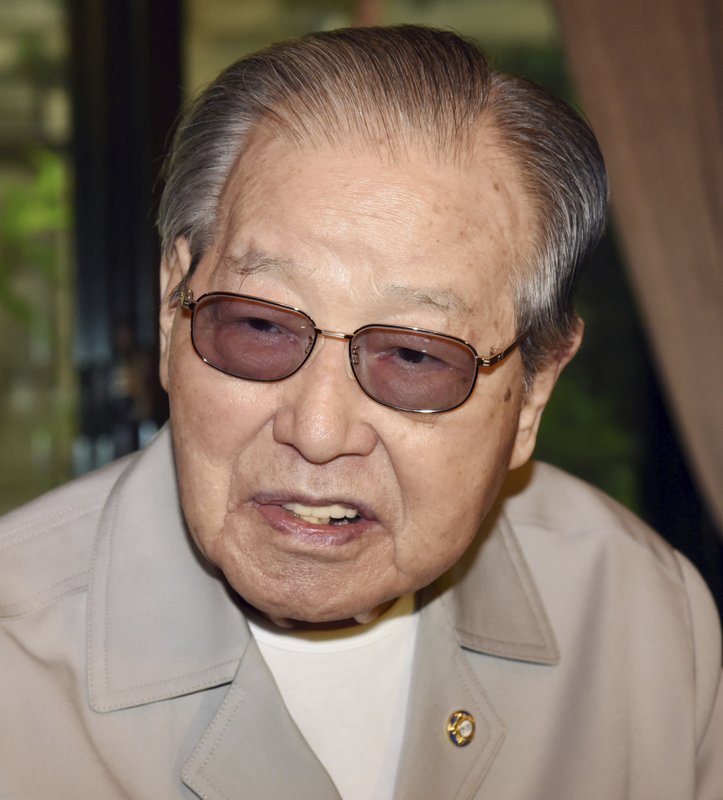
Ex-S. Korean premier Kim Jong-pil, spy agency founder, dies

In this Aug.19, 2016, photo, Kim Jong-pil, the founder of South Korea’s spy agency who also served twice as prime minister, first under his dictator boss and later under a man his agency kidnapped, talks with South Korean lawmakers at his house in Seoul, South Korea. Kim has died on Saturday, June 23, 2018 at the age of 92.
Kim Jong-pil, the founder of South Korea’s spy agency whose political skills helped him also serve twice as prime minister, first under his dictator boss and later under a man his agency kidnapped, has died. He was 92.

Kim was declared dead on arrival at Seoul’s Soonchunhyang University Hospital from his home on Saturday, said hospital official Lee Mi-jong. He described the cause of death as age-related complications.

South Korea’s presidential office released a statement saying Kim’s “fingerprints and footprints that marked South Korea’s modern political history will not be easily erased.”

5 April 2017

N. Korea fires ballistic missile ahead of Trump-Xi meeting

Visitors sit in front of the TV screen showing a news program reporting about North Korea's missile firing, at Seoul Train Station in Seoul, South Korea, Wednesday, April 5, 2017. North Korea fired a ballistic missile into its eastern waters Wednesday, U.S. and South Korean officials said, amid worries the North might conduct banned nuclear or rocket tests ahead of the first summit between President Donald Trump and his Chinese counterpart Xi Jinping this week. The letters read "North Korea fired a ballistic missile into its eastern waters."
North Korea fired a newly developed powerful ballistic missile into its eastern waters Wednesday, U.S. and South Korean officials said, amid worries the North might conduct nuclear or long-range rocket tests ahead of the first summit between President Donald Trump and his Chinese counterpart Xi Jinping this week.

The initial U.S. and South Korean assessments indicated it was a KN-15 medium-range missile, whose first publicly known test in February was considered by many foreign experts as a potentially worrying development. It uses solid fuel already loaded inside the missile, which would shorten launch preparation times, boost the weapon's mobility and make it harder for outsiders to detect the signs of its liftoff.

19 January 2017

S. Koreans' ties with Samsung are lifelong, often conflicted

In this Wednesday, Jan. 18, 2017, photo, Lee Jae-yong, center, a vice chairman of Samsung Electronics Co. arrives for the hearing at the Seoul Central District Court in Seoul, South Korea. Many South Koreans were shocked at the sight of Lee being dragged into custody and then released when a court declined to formally arrest him. Its quite difficult for outsiders to fully grasp how Samsung is inextricably woven into the psychological fabric of this small, proud country.
The family smartphones? An assortment of Samsung Galaxies. The flat-screen TV that illuminates the living room? A Samsung SUHD, with the brand name sparkling on the nameplate. The maker of the digital toilet seat? You guessed it: Samsung.
It's difficult for people outside South Korea to fully grasp what Samsung, a truly global brand, means inside its home country, where it is far more than just another big company. It is seen variously as both a talisman and a millstone, as national savior and greedy business behemoth. Those diverse views only intensified Thursday when a court rejected prosecutors' request to arrest Samsung heir and Vice Chairman Lee Jae-yong in the corruption scandal surrounding impeached South Korean President Park Geun-hye.

Court denies a request to arrest Samsung's de facto head

Lee Jae-yong, a vice chairman of Samsung Electronics Co. gets into a car as he leaves after waiting for the court's decision in front of a detention center in Uiwang, South Korea, Thursday, Jan. 19, 2017. A Seoul court denied a request to arrest Samsung Electronics Vice Chairman Lee Jae-yong, allowing Lee to return home, a setback to prosecutors investigating an influence-peddling scandal that toppled South Korea's president.
A Seoul court on Thursday denied a request to arrest one of South Korea's most powerful men, the heir to the Samsung Electronics juggernaut, in a setback to prosecutors investigating an influence-peddling scandal that toppled South Korea's president.
The Seoul Central District Court said that a judge concluded that there was not enough justification to detain the 48-year-old billionaire Samsung vice chairman, Lee Jae-yong, at this stage.

16 January 2017

South Korea seeks arrest of Samsung scion in graft scandal

In this Dec, 6, 2016 file photo, Lee Jae-yong, a vice chairman of Samsung Electronics Co. arrives for hearing at the National Assembly in Seoul, South Korea. The special prosecutors office said Monday, Jan. 16, 2017 that it requested an arrest warrant for Lee, the 48-year-old Samsung Electronics vice chairman as a bribery suspect in the influence-peddling scandal that led to the impeachment of South Korea's president.
In a departure from the leniency typically given South Korean big businesses, prosecutors on Monday requested the arrest of the de facto head of Samsung Electronics, the country's most valuable company, in an influence-peddling scandal that has toppled the country's president.
Lee Jae-yong, the 48-year-old vice chairman at Samsung Electronics, faces allegations of embezzlement, of lying under oath during a parliamentary hearing and of offering a bribe of 43 billion won ($36 million) to a long-time friend of impeached President Park Geun-hye, according to Lee Kyu-chul, a spokesman for a special prosecutors' team investigating the political scandal.

13 September 2016

US flies bombers over S.Korea in show of force against North

U.S. B-1 bomber, center, flies over Osan Air Base with U.S. jets in Pyeongtaek, South Korea, Tuesday, Sept. 13, 2016. The United States has flown nuclear-capable supersonic bombers over ally South Korea in a show of force meant to cow North Korea after its fifth nuclear test and also to settle rattled nerves in the South.
The United States on Tuesday sent two nuclear-capable supersonic bombers streaking over ally South Korea in a show of force meant to cow North Korea after its recent nuclear test and also to settle rattled nerves in the South.
The B-1B bombers, escorted by U.S. and South Korean jets, were seen by an Associated Press photographer as they flew over Osan Air Base, which is 120 kilometers (75 miles) from the border with North Korea, the world's most heavily armed. The bombers were likely to return to Andersen Air Force Base in Guam, without landing in South Korea.

8 May 2016

Kim Jong Un says Pyongyang won't use nukes first

A man pushes his bicycle past the Pyongyang train station which is decorated with the ruling Workers' Party flags Sunday, May 8, 2016, in Pyongyang, North Korea. North Korean leader Kim Jong Un said during a critical ruling party congress that his country will not use its nuclear weapons first unless its sovereignty is invaded. He also announced a five-year plan starting this year to develop the North's dismal economy and identified improving the country's power supply and increasing its agricultural and light-manufacturing production as the critical parts of the program, state media reported.
North Korean leader Kim Jong Un said his country will not use its nuclear weapons first unless its sovereignty is invaded, in a speech during a critical party congress that struck a conciliatory note in the face of international pressure over its recent nuclear test and long-range rocket launch.
Kim said he is ready to improve ties with "hostile" nations, and called for more talks with rival South Korea to reduce misunderstanding and distrust between them. He also urged the United States to stay away from inter-Korean issues, according to the official Korean Central News Agency.

10 January 2016

Kim visits military as Koreas slide into Cold War standoff


South Korean soldiers stand in front of equipment used for propaganda broadcasts near the border area between South Korea and North Korea in Yeoncheon, South Korea, Friday, Jan. 8, 2016.
North Korea's leader has taken a victory tour of military headquarters to celebrate the country's widely disputed claim of a hydrogen bomb test.
Kim Jong Un called the nuclear test "a self-defensive step for reliably defending the peace on the Korean Peninsula and the regional security from the danger of nuclear war caused by the U.S.-led imperialists," according to a dispatch Sunday from state-run Korean Central News Agency.

8 January 2016

Seoul delivers barrage of K-pop across border to North Korea

In this Oct. 6, 2013, file photo, South Korean K-Pop girl group Apink performs during Hallyu Dream Concert in Gyeongju, South Korea. South Korea is trying to get under the skin of its archrival with border broadcasts that feature not only criticism of North Korea’s nuclear program, troubled economy and human rights abuses, but also a unique homegrown weapon: K-pop. “Just Let Us Love” by a popular female group Apink is one of the songs being broadcast across the Demilitarized Zone between North and South Korea.
South Korea tries to get under the skin of its archrival with border broadcasts that feature not only criticism of North Korea's nuclear program, troubled economy and human rights abuses, but also a unique homegrown weapon: K-pop.
Performers on the propaganda playlist Seoul began blasting across the border Friday include a female K-pop band that rose to fame when its members fell multiple times on stage, and a middle-aged singer who rose from obscurity last year with a song about living for 100 years. The broadcasts are in retaliation for the North's nuclear test Wednesday.

6 January 2016

N. Korea says it conducts successful powerful H-bomb test


South Koreans watch a TV news program showing North Korean leader Kim Jong Un's New Year speech, at the Seoul Railway Station in Seoul, South Korea, Friday, Jan. 1, 2016. Kim said in an annual New Year speech that he's ready for war if provoked by "invasive" outsiders but stayed away from past threats centering on the country's nuclear weapons and long-range missile ambitions The letters read: " Kim Jong Un's New Year Speech."
North Korea said Wednesday it had conducted a powerful hydrogen bomb test, a defiant and surprising move that, if confirmed, would be a huge jump in Pyongyang's quest to improve its still-limited nuclear arsenal.
A television anchor said in a typically propaganda-heavy statement that the North had tested a "miniaturized" hydrogen bomb, elevating the country's "nuclear might to the next level" and providing it with a weapon to defend against the United States and its other enemies.

1 January 2016

North Korean leader talks war but doesn't comment on nukes

South Koreans watch a TV news program showing North Korean leader Kim Jong Un's New Year speech, at the Seoul Railway Station in Seoul, South Korea, Friday, Jan. 1, 2016. Kim said in an annual New Year speech that he's ready for war if provoked by "invasive" outsiders but stayed away from past threats centering on the country's nuclear weapons and long-range missile ambitions.
North Korean leader Kim Jong Un said in an annual New Year's speech Friday that he was ready for war if provoked by "invasive" outsiders, but he stayed away from past threats involving the country's nuclear weapons and long-range missile ambitions.
His comments stuck to well-worn propaganda meant to lift his image for the elite residents of one of the world's poorest, most closed countries, and could be read as an attempt to keep ties with rivals Washington and Seoul from getting worse so he can try to turn around a miserable economy and further solidify his leadership.