Showing posts with label UAE. Show all posts

17 March 2017

Somali pirates release oil tanker and crew, officials say

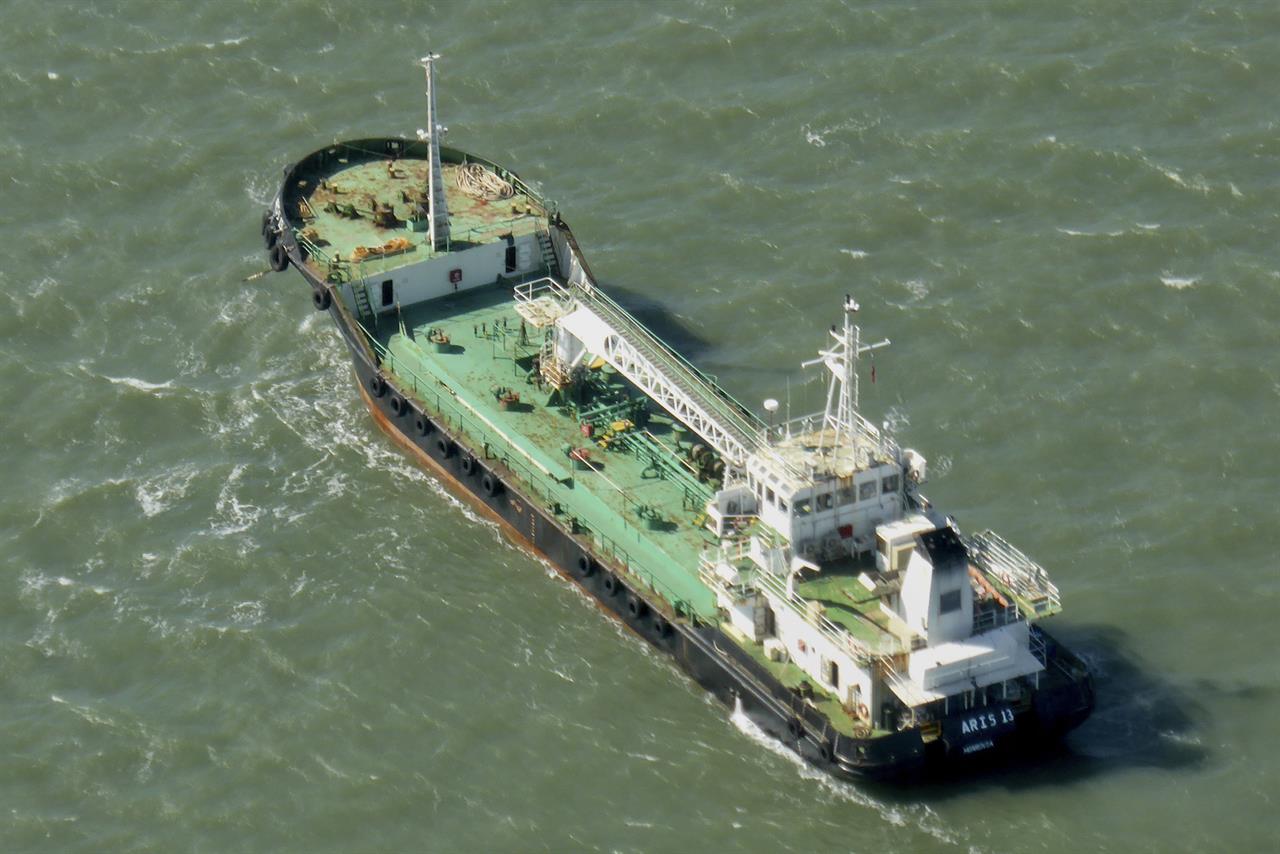
In this photo taken Monday, Oct. 27, 2014, the Aris 13 oil tanker is seen from a helicopter in the harbor of Gladstone, Australia. Pirates have hijacked the Aris 13 oil tanker off the coast of Somalia, officials and piracy experts said Tuesday, March 14, 2017, the first such seizure of a large commercial vessel on the crucial global trade route since 2012.
Somali pirates who seized a Comoros-flagged oil tanker earlier this week after five years without a major hijacking in the region have released the ship and its crew without conditions, officials said late Thursday.

Security official Ahmed Mohamed told The Associated Press the pirates disembarked the ship, which was heading to Bossaso port, the region's commercial hub, with its eight Sri Lankan crew members aboard.

15 March 2017

Somali pirates demand ransom for oil tanker, EU force says

In this Sunday, Sept. 23, 2012 file photo, masked and armed Somali pirate Hassan stands near a Taiwanese fishing vessel washed ashore after the pirates were paid a ransom and the crew were released in the once-bustling pirate den of Hobyo, Somalia. Pirates have hijacked an oil tanker off the coast of Somalia, Somali officials and piracy experts said Tuesday, March 14, 2017, in the first hijacking of a large commercial vessel there since 2012.
Armed men are demanding a ransom for the release of an oil tanker they have seized off the coast of Somalia and the crew is being held captive, the European Union anti-piracy operation in the region announced late Tuesday.

An EU Naval Force statement said the operation had finally made contact with the ship's master, who confirmed that armed men were aboard the Comoros-flagged tanker Aris 13.

1 January 2016

New Year's Eve skyscraper fire in Dubai burns on into 2016

Fireworks illuminate the Burj Khalifa as a tower burns behind it in Dubai, United Arab Emirates on Friday, Jan. 1, 2016.
A massive skyscraper fire in Dubai that began on New Year's Eve has burned on into the first morning of 2016.
The blaze at the Address Downtown, one of the most upscale hotels and residences in Dubai, started around 9:30 p.m. Thursday. More than 12 hours later on Friday morning, Dubai firefighters largely watched the fire from the ground, unable at one point to use a water hose on a ladder truck.

Dubai New Year fireworks kick off while nearby tower blazes

Smoke and flames pouring from a residential building, which also contains the Address Downtown Hotel, in Dubai, United Arab Emirates, Thursday evening, Dec. 31, 2015.
A 63-story luxury hotel was engulfed in flames even as a massive New Year's fireworks display kicked off at the world's tallest skyscraper nearby, while tens of thousands of people whistled and cheered at early Friday's pyrotechnics.
Just minutes before the fireworks began in the Gulf emirate of Dubai, large explosions could be heard from inside the burning building, which was cloaked in thick black smoke. Other blasts followed later during the night. It was not clear what caused them.

16 August 2015

Indian PM kicks off UAE visit with mosque tour

Indian Prime Minister Narendra Modi, middle, takes a selfie next to Sheikh Hamdan bin Mubarak Al Nahyan, UAE Minister of Higher Education and Scientific Research, left, as they tour the Sheikh Zayed Grand Mosque during the first day of his two-day visit to the UAE, in Abu Dhabi, United Arab Emirates, Sunday, Aug. 16, 2015. The UAE is home to over two million Indian expatriates and this is the first visit by an Indian premier in over three decades.
India's prime minister began a two-day tour of the United Arab Emirates with a visit to its largest mosque on Sunday in a gesture of outreach to Muslims ahead of a planned speech to tens of thousands of Indian expatriates and bilateral meetings aimed at improving already strong trade links.

17 June 2014

Dubai Creek, heart of a changed city

Beneath a glitzy skyline, wooden boats ply Dubai Creek, the historic heart of a city that was transformed in little more than a generation from a tiny pearling and fishing port to a global trading hub.


From early morning to late evening the creek is abuzz with daily commuters and tourists riding in abras, the wooden boats that have been used for more than a century and are still built by hand nearby. The 25-cent passage from one bank to the other is one of the only bargains left in a city where much of the population is expatriates lured to the Gulf emirate by job opportunities.


Unlike the rest of the city, the Dubai Creek area has until now been left relatively untouched by developers, offering a glimpse into the modest beginnings of a city that is now a byword for wealth, excess and overnight development.

"The creek is very much the heart of the city, physically and metaphorically," says Yasser Elsheshtawy, associate professor of architecture at the United Arab Emirates University. "You know, that's really where everything started."

The city is awaiting the results of a bid for Dubai Creek to be declared a UNESCO World Heritage Site, and a $544 million creek-side project has been approved by Sheik Mohammed bin Rashid Al Maktoum, UAE vice president and prime minister and ruler of Dubai, that aims to transform the area into a cultural and artistic hub for the city. 

Here are images from Associated Press photographer Kamran Jebreili of Dubai Creek. 
(AP)
In this Monday, May 26, 2014 photo, traditional abras, or taxi boats, cross the creek waters from Bur Dubai to Deira, in Dubai, United Arab Emirates. Beneath a glitzy skyline wooden boats ply Dubai Creek, the historic heart of a city that was transformed in little more than a generation from a tiny pearling and fishing port to a global trading hub. In this Thursday, May 29, 2014 photo, an Asian laborer carries imported goods to a dhow at the creek in Dubai, United Arab Emirates. Beneath a glitzy skyline wooden boats ply Dubai Creek, the historic heart of a city that was transformed in little more than a generation from a tiny pearling and fishing port to a global trading hub. In this Tuesday, May 13, 2014 photo, an Iranian sailor climbs down a ladder from his dhow for uploading goods at the creek in Dubai, United Arab Emirates. The Creek has constantly been an important harbor for small and medium size dhows which sail to the ports of the Persian Gulf region, the countries of the Indian subcontinent and East Africa, loaded with different goods which are re-exported to these various regions. This Monday, May 26, 2014 photo, shows abra taxi boats leaving their station in Bur Dubai to take passengers to Deira in Dubai, United Arab Emirates. From early morning to late evening the creek is abuzz with daily commuters and tourists riding in abras, the wooden boats that have been used for more than a century and are still built by hand nearby. The 25-cent passage from one bank to the other is one of the only bargains left in a city where much of the population is expatriates lured to the Gulf emirate by job opportunities. In this Tuesday, May 27, 2014 photo, an abra, or boat taxi, driver performs the evening payers on his boat at the creek in Dubai, United Arab Emirates. Beneath a glitzy skyline wooden boats ply Dubai Creek, the historic heart of a city that was transformed in little more than a generation from a tiny pearling and fishing port to a global trading hub. In this Tuesday, June 3, 2014 photo, a man rides his bicycle past the Sheik Mohammed bin Rashid Al Maktoum House, a historic building by the creek, in Dubai, United Arab Emirates. The city is awaiting the results of a bid for Dubai Creek to be declared a UNESCO World Heritage Site, and a $544 million creek-side project has been approved by Sheik Mohammed bin Rashid Al Maktoum, UAE vice president and prime minister and ruler of Dubai, that aims to transform the area into a cultural and artistic hub for the city. In this Monday, May 26, 2014 photo, people shop at a souq by the creek in Dubai, United Arab Emirates. Unlike the rest of the city, the Dubai Creek area has until now been left relatively untouched by developers, offering a glimpse into the modest beginnings of a city that is now a byword for wealth, excess and overnight development. In this Monday, May 26, 2014 photo, tourists and residents cross the creek waters which cuts through the heart of the city, on a traditional abra, or taxi boat, in Dubai, United Arab Emirates. From early morning to late evening the creek is abuzz with daily commuters and tourists riding in abras, the wooden boats that have been used for more than a century and are still built by hand nearby. The 25-cent passage from one bank to the other is one of the only bargains left in a city where much of the population is expatriates lured to the Gulf emirate by job opportunities. In this Friday, April 25, 2014 photo, a lit boat on the creek waters in Dubai, United Arab Emirates. Unlike the rest of the city, the Dubai Creek area has until now been left relatively untouched by developers, offering a glimpse into the modest beginnings of a city that is now a byword for wealth, excess and overnight development. In this Wednesday, May 28, 2014 photo, people shop at a souq by the creek in Dubai, United Arab Emirates. Unlike the rest of the city, the Dubai Creek area has until now been left relatively untouched by developers, offering a glimpse into the modest beginnings of a city that is now a byword for wealth, excess and overnight development. In this Thursday, May 29, 2014 photo, tourists and residents cross the creek waters which cuts through the heart of the city, on a traditional abra, or taxi boat, in Dubai, United Arab Emirates. From early morning to late evening the creek is abuzz with daily commuters and tourists riding in abras, the wooden boats that have been used for more than a century and are still built by hand nearby. The 25-cent passage from one bank to the other is one of the only bargains left in a city where much of the population is expatriates lured to the Gulf emirate by job opportunities. In this Monday, May 26, 2014 photo, tourists and residents cross the creek waters which cuts through the heart of the city, on a traditional abra, or taxi boat, in Dubai, United Arab Emirates. The 14 kilometer (9 mile) Khor Dubai in Arabic or Dubai Creek, is a natural seawater inlet of the Persian Gulf located in the heart of city that runs South to East and ends at Ras Al-Khor wildlife Sanctuary. The creek that divides the city into two parts, Bur Dubai and Deira, has played a major historical role in the economic development of the region. In this Monday, May 26, 2014 photo, trading dhows for uploading goods are docked at the creek in Dubai, United Arab Emirates. Beneath a glitzy skyline wooden boats ply Dubai Creek, the historic heart of a city that was transformed in little more than a generation from a tiny pearling and fishing port to a global trading hub. In this Wednesday, May 28, 2014 photo, with skyscrapers along the Sheikh Zayed highway, at background, pink flamingos look for food by the creek, at the Ras Al Khor Wildlife Sanctuary in Dubai, United Arab Emirates. Beneath a glitzy skyline wooden boats ply Dubai Creek, the historic heart of a city that was transformed in little more than a generation from a tiny pearling and fishing port to a global trading hub.