Showing posts with label money. Show all posts

29 September 2017

India’s flagging economy draws dire warnings of recession

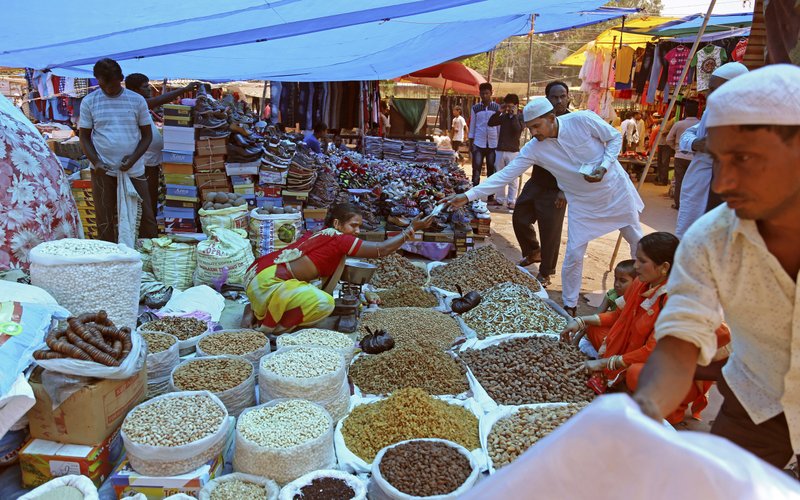
In this June 16, 2017, file photo, Indians buy dry fruits from a roadside vendor at a market in New Delhi, India. Three years later Prime Minister Narendra Modi came to power, India’s economic prospects are looking decidedly more grim. India’s economic expansion has slowed to its lowest level in three years. Small businesses are struggling, or even shutting down, after a major overhaul to both the country’s currency and sales tax system.
Prime Minister Narendra Modi came to power on a euphoric wave of promises to boost India’s economy, add millions of jobs and bring “good times” to the developing nation.

Three years later, India’s economic prospects look decidedly grimmer. India’s economic expansion has slowed to its lowest level in three years. Small businesses are struggling, or even shutting down, after overhauls of the nation’s currency and sales tax system. Modi’s own allies warn of a dire outlook, with some raising the specter of an economic depression.

30 December 2016

Benefits of Indian cash overhaul elusive as deadline passes

Indians stand in a queue outside a bank in New Delhi, India, Friday, Dec. 30. 2016. India yanked most of its currency bills from circulation without warning, delivering a jolt to the country's high-performing economy and leaving countless citizens scrambling for cash. Still, as Friday's deadline for depositing old 500- and 1,000-rupee notes draws to a close, Prime Minister Narendra Modi's government has called the demonetization drive a great success in drawing out tax dodgers and eliminating graft.
Fifty days ago, India yanked most of its currency from circulation without warning, jolting the economy and leaving most citizens scrambling for cash. As the deadline for exchanging the devalued 500- and 1,000-rupee notes for new ones hit on Friday, many Indians were still stuck waiting in long bank lines.
Empty ATMs and ever-changing rules prevented people from withdrawing money, and many small, cash-reliant businesses from cinemas to neighborhood grocery stores suffered huge losses or went under.

Benefits of Indian cash overhaul elusive as deadline passes

In this Thursday, Dec. 29, 2016 photo, an Indian woman, who had come to deposit money, argues with a bank officer in New Delhi, India. On Nov. 8, India yanked most of its currency bills from circulation without warning, delivering a jolt to the country’s high-performing economy and leaving countless citizens scrambling for cash. Still, as Friday’s deadline for depositing old 500- and 1,000-rupee notes draws to a close, Prime Minister Narendra Modi’s government has called the demonetization drive a great success in drawing out tax dodgers and eliminating graft.
Fifty days ago, India yanked most of its currency from circulation without warning, jolting the economy and leaving most citizens scrambling for cash. As the deadline for exchanging the devalued 500- and 1,000-rupee notes for new ones hits Friday, many Indians are still stuck waiting in long bank lines.
Empty ATMs and ever-changing rules are preventing people from withdrawing money, and many small, cash-reliant businesses from cinemas to neighborhood grocery stores are suffering huge losses or going under.

24 November 2016

Sudden currency move spoils business at Indian food market

In this Friday, Nov. 18, 2016 photo, a laborer sits on his cart waiting for work at Azadpur Mandi, one of Asia's largest wholesale market for fruits and vegetables in New Delhi, India. Business at the massive New Delhi market is evaporating, the food spoiling and wasted, two weeks after the government's surprise currency move made more than 80 percent of India's banknotes useless. By withdrawing all 500- and 1,000-rupee notes from circulation, the government is trying to clean India's economy of "black money," or untaxed wealth. Its success remains to be seen, but for now the move has created serpentine queues outsides banks and ATMs of people replacing their rupee notes or making small withdrawals.
The scale of India's cash economy can be seen in the Azadpur Mandi wholesale fruit and vegetable market. Trucks bring load after load of fresh produce to its grimy lanes every day. Then a complex web of wholesale merchants, smaller traders and retailers delivers the produce to most of north India.
Almost every transaction, like most in India, is done in cash. And business at the massive New Delhi market is evaporating, the food spoiling and wasted, two weeks after the government's surprise currency move made more than 80 percent of India's banknotes useless.

18 November 2016

The effects of India's currency reform? "Chaos" say analysts

In this Nov. 17, 2016 file photo, Indians stand in a queue to deposit and exchange discontinued currency notes outside a bank on the outskirts of Allahabad, India. The sudden withdrawal of 86 percent of India's currency has left cash in short supply, retail sales stumbling and wholesale markets in turmoil.
The sudden withdrawal of 86 percent of India's currency has left cash in short supply, retail sales stumbling and wholesale markets in turmoil.
That's just the immediate fallout from Prime Minister Narendra Modi's surprise effort to stamp out corruption by making cash hoards in large denomination bills worthless. But what lies ahead could be even worse, some analysts say.

15 November 2016

India struggles as millions throng banks to swap currency

Indians stand in queues at a bank to exchange or deposit discontinued currency notes in New Delhi, India, Tuesday, Nov. 15, 2016. Chaotic scenes played out across India with long lines growing even longer and scuffles breaking out, as millions of anxious people tried to change old currency notes that became worthless days earlier when the government demonetized high-value bills.
India's government said Tuesday it will use indelible ink to mark the fingers of people swapping scrapped currency notes at banks as authorities struggle to deal with the bedlam caused by the sudden demonetizing of the country's highest-denomination bills.

9 November 2016

India scraps high currency notes overnight to fight graft

Indians crowd a gas station, one of the few places still accepting the high denomination 1000 and 500 currency notes, in New Delhi, India, Tuesday, Nov. 8, 2016. India's highest-denomination currency notes are being withdrawn immediately from circulation, the country's prime minister said Tuesday night, a surprise announcement designed to fight corruption and target people who have stashed away immense amounts of cash. As of midnight Tuesday, 500- and 1,000-rupee notes, worth about $7.50 and $15, will have no cash value, Prime Minister Narendra Modi said in a televised address.
India scrapped its highest-denomination currency notes overnight, delivering a blow to black-market money launderers but plunging hundreds of millions of common citizens holding cash savings into fear and uncertainty.
Within hours of Prime Minister Narendra Modi announcing the surprise move in a televised address, people thronged to ATMs, standing in long lines in hopes of grabbing bills that might still be in circulation on Wednesday.

17 December 2015

US rate hike ends wait, but not uncertainty for Asia

People are reflected on the electronic board of a securities firm in Tokyo,Thursday, Dec. 17, 2015. Asian stocks posted broad gains Thursday after the Federal Reserve ended protracted uncertainty in markets by raising interest rates for the first time in nearly a decade and signaling that further increases will be gradual.
The Federal Reserve's rate hike was welcomed in Asia as a sign of strength in the U.S., one of the region's biggest export markets. But it could complicate Chinese efforts to avoid a sharper economic slowdown and keep the yuan steady.
The U.S. central bank on Wednesday raised the Federal Funds Rate by a quarter percentage point, the first such increase in nearly a decade. The decision ended a long period of uncertainty about when the Fed would begin winding down the easy money deployed to help heal the economic damage of the 2008 financial crisis.

2 December 2015

Facebook CEO, now a father, will give away most of his money

In this undated photo provided by Mark Zuckerberg, Max Chan Zuckerberg is held by her parents, Mark Zuckerberg and Priscilla Chan Zuckerberg. Facebook CEO Mark Zuckerberg and his wife announced the birth of their daughter, Max, as well as plans to donate most of their wealth to a new organization that will tackle a broad range of the world's ills.
Talk about birth announcements: Facebook CEO Mark Zuckerberg and his wife say they'll devote nearly all their wealth — roughly $45 billion — to solving the world's problems in celebration of their new baby daughter, Max.
Zuckerberg's wife, Priscilla Chan, gave birth to a 7-pound, 8-ounce daughter last week. But the couple didn't put out the news until Tuesday, when Zuckerberg posted it on Facebook, of course.

25 November 2014

Bollywood women soar but ask: Where's the money?

In this Aug. 23, 2014 file photo, Bollywood actress Priyanka Chopra speaks during a promotional event for her film "Mary Kom" in Ahmadabad, India. This is Bollywood’s year of the woman. Some of the biggest hits in India's prolific movie industry this year have female leads in female-oriented stories. In “Mary Kom,” Chopra plays a female Olympic bronze-medal winning boxer. Previously, women were relegated to playing the male lead actor’s girlfriend, sister or mother in subservient roles reflecting the traditional dominance of men in Indian society. But for all their box-office success and newfound prominence, Bollywood actresses are asking: Where is the money?
This is Bollywood's year of the woman. Some of the biggest hits in India's prolific movie industry this year have female leads in female-oriented stories.
In this summer's surprise hit, "Queen," Kangana Ranaut is the spunky heroine who embarks on her honeymoon alone after she is jilted the day before her big fat Indian wedding. In "Mary Kom," Priyanka Chopra plays a female Olympic bronze medal-winning boxer. Previously, women were relegated to playing the male lead's girlfriend, sister or mother in subservient roles reflecting the traditional dominance of men in Indian society.

22 July 2014

Going for the kill: Fat pay packet triggers hangmen's rush in Kerala

Kerala has gone for the kill with a fat pay-packet for the man who does the dirty job – hang the death row convicts. 
Facing an acute shortage of jail hangmen, the jail department submitted a suggestion to hike their fee from Rs. 500 to Rs. 2 lakh.
The move has virtually opened the floodgates.
In the state 16 convicts are facing gallows now and it is the duty of the jail department to keep hangman ready.
"According to 1957 jail manuals a hangman gets Rs. 500 for a single execution. Since it wasn't renewed all these years a suggestion was given to renew it substantially.  It really triggered a massive response," said Kannur central jail superintendent  Ashokan Arippa.