Showing posts with label militancy. Show all posts

3 May 2017

India summons Pakistan envoy over killing of 2 soldiers

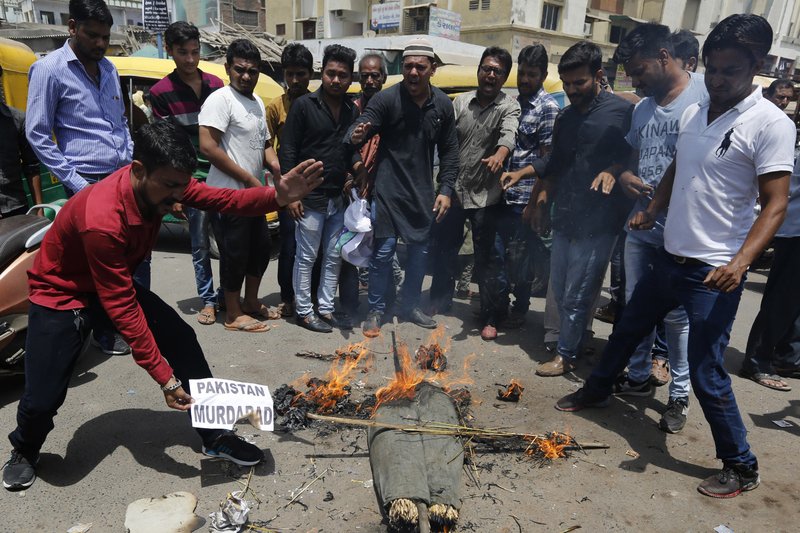
Indians burn an effigy of Pakistan and shout anti-Pakistan slogans during a protest in Ahmadabad, India, Wednesday, May 3, 2017. Two Indian soldiers were killed and their bodies mutilated Monday in an ambush by Pakistani soldiers along the highly militarized de facto border that divides the disputed region of Kashmir between the nuclear-armed rivals, the Indian army said. But Pakistan denied any such attack, calling the Indian claims false.
A top Indian diplomat Wednesday summoned Pakistan's ambassador to demand that Islamabad take action against soldiers and officers responsible for the killing and mutilation of two Indian soldiers.

The Indian army has said the soldiers were killed and mutilated Monday in an ambush by Pakistani soldiers along the highly militarized de-facto border that divides the disputed region of Kashmir between the nuclear-armed rivals.

1 May 2017

India says Pakistan killed 2 Indian soldiers in Kashmir

Two Indian soldiers were killed and their bodies mutilated Monday in an ambush by Pakistani soldiers along the highly militarized de facto border that divides the disputed region of Kashmir between the nuclear-armed rivals, the Indian army said. But Pakistan denied any such attack, calling the Indian claims false.

Separately, five police officials and two bank employees were killed when suspected rebels ambushed a bank van in Indian-controlled Kashmir, police said.

28 March 2017

3 Kashmir civilians killed in protests against Indian rule

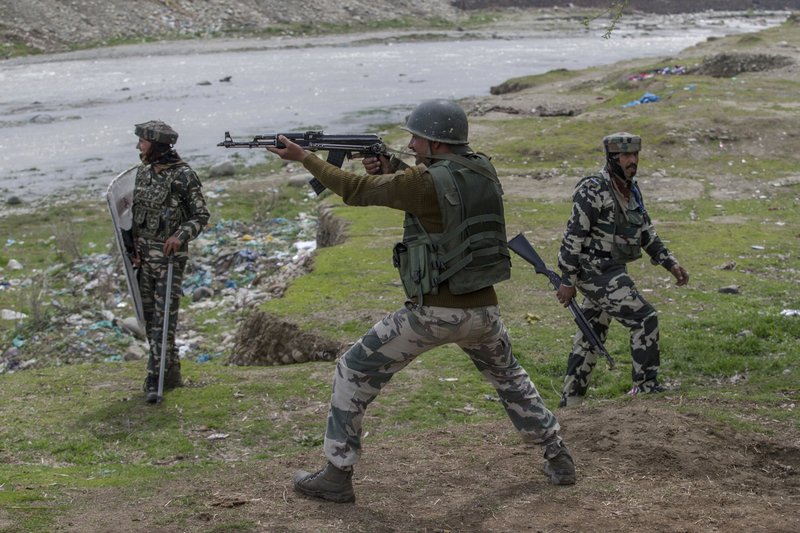
An Indian paramilitary soldier fires at Kashmiri protesters near the site of a gun battle in Chadoora town, about 25 kilometers (15 miles) south of Srinagar, Indian controlled Kashmir, Tuesday, March 28, 2017. Three civilians were killed and 28 other people were injured in anti-India protests that erupted Tuesday following a gunbattle between rebels and government forces that killed a rebel in disputed Kashmir, police and witnesses said. Witnesses said intense clashes between rock-throwing protesters and government forces erupted just a few hundred meters (yards) from the besieged house, with police and paramilitary soldiers firing shotgun pellets and tear gas to stop the protest. Later, government forces fired into the crowd, police said.
Three civilians were killed and 28 other people were injured in anti-India protests that erupted Tuesday following a gunbattle between rebels and government forces that killed a rebel in disputed Kashmir, police and witnesses said.

The gunbattle began after police and soldiers cordoned off the southern town of Chadoora following a tip that at least one militant was hiding in a house, said Inspector-General Syed Javaid Mujtaba Gillani.

As the fighting raged, hundreds of residents chanting anti-India slogans marched near the area in an attempt to help the trapped rebel escape.

3 October 2016

Indian police say gun battle has ended at Kashmir army camp

An Indian army soldier guards as Kashmiri villagers pass on horse cart outside the base camp which was attacked by suspected militants at Baramulla, northwest of Srinagar, Indian controlled Kashmir, Monday, Oct. 3, 2016. A gun battle with a group of militants who attacked an Indian army camp in the Indian portion of Kashmir has ended early Monday morning, police said.
A gun battle with a group of militants who attacked an Indian army camp in the Indian portion of Kashmir that killed one Indian paramilitary soldier and wounded another has ended early Monday morning, police said.
A senior police official speaking on customary condition of anonymity said search operations were on at the base which was attacked late Sunday by an unspecified number of militants firing grenades and guns.

30 September 2016

Dueling truths follow Indian raid in Pakistani Kashmir

In this Sept. 24, 2016 file photo, an Indian Border Security Force soldier looks at the Pakistan side of the border through a binocular at Ranbir Singh Pura, about 35 kilometers (22 miles) from Jammu, India. In New Delhi, they say that highly trained Indian soldiers slipped across the de facto border and into Pakistani-controlled Kashmir in a daring nighttime raid, killing anti-India militants preparing to launch attacks. In Islamabad, they say that only one Indian soldier made it across the border, and he was captured, with Pakistani forces easily driving back the other Indians, who retreated as soon as they encountered resistance. The dueling tales of courageous forces serve politics on both sides of the border, with powerful forces in each country able to proclaim their courage in the face of aggression.
In New Delhi, they say that highly trained Indian soldiers slipped across the de facto border and into Pakistani-controlled Kashmir in a daring nighttime raid, killing anti-India militants preparing to launch attacks.
In Islamabad, they say only one Indian soldier made it across the border — and he was captured — with Pakistani forces easily driving back the other Indians, who retreated as soon as they encountered resistance.

India says it has struck militants across Kashmir frontier

Members of the Pakistani Civil Society Forum chant slogans during a demonstration for peace and condemning the raising tension between Pakistan and India, in Lahore, Pakistan, Wednesday, Sept. 28, 2016. Pakistan's defense minister says its nuclear-armed rival India will "disintegrate" when Kashmir gains independence. Khawaja Muhammad Asif said that Pakistan will continue to extend moral support to the people of the disputed Himalayan region, which is split between Pakistani and Indian control but claimed in its entirety by both.
India said Thursday it carried out "surgical strikes" against militants across the highly militarized frontier that divides the Kashmir region between India and Pakistan, in an exchange that escalated tensions between the nuclear-armed neighbors.
Pakistan dismissed the reports that India's military had targeted "terrorist launch pads" inside the Pakistan-controlled part of Kashmir. Islamabad said instead that two of its soldiers were killed in "unprovoked" firing by India across the border.

28 September 2016

Pakistan says India will 'disintegrate' when Kashmir is free

In this Friday, April 25, 2008 file photo, Pakistani Petroleum Minister Khawaja Mohammed Asif, right, shakes hands with his Indian counterpart Murli Deora after their joint news conference in Islamabad, Pakistan. Pakistan's Defense Minister says its nuclear-armed rival India will "disintegrate" when the people living in disputed Himalayan region of Kashmir got independence from New Delhi. Khawaja Muhammad Asif said Wednesday, Sept. 28, 2016 that Pakistan will continue to extend moral support to Kashmiri people in their struggle.
Pakistan's defense minister on Wednesday said India will "disintegrate" when Kashmir gains independence, in a sign of mounting tensions between the nuclear-armed rivals.
Khawaja Muhammad Asif told The Associated Press that Pakistan will continue to extend moral support to the people of the disputed Himalayan region, which is split between Pakistani and Indian control but claimed in its entirety by both.

27 September 2016

India says Pakistan believes terror will bring territory

Sushma Swaraj, Minister of External Affairs for India, speaks during the 71st session of the United Nations General Assembly at U.N. headquarters, Monday, Sept. 26, 2016.
Pakistan continues to believe terrorist attacks will allow it to obtain territory it covets in Jammu and Kashmir, India's foreign minister said Monday.
In her speech before the U.N. General Assembly, Sushma Swaraj also rejected accusations made by Pakistan's prime minister from the same podium last week that India violates human rights, calling them "baseless."

23 September 2016

India trying diplomacy in dealing with rival Pakistan

In this May 27, 2014 file photo, Indian Prime Minister Narendra Modi, left, walks to shake hand with his Pakistani counterpart Nawaz Sharif before the start of their meeting in New Delhi, India. Even with his own officials saying the Sept. 18, 2016 attack on an Indian military base was launched by Pakistan-based militants, Modi is relying on diplomacy more than saber-rattling. In large part, this is because Modi and Indian forces already must defuse the massive and relentless anti-India protests that have swept its portion of Kashmir, triggered by the killing of a young rebel leader in July. In a speech at the U.N. General Assembly on Sept. 21, Sharif strongly criticized India's suppression of protests in Kashmir, calling for an independent inquiry into killings there and a U.N. fact-finding mission to investigate what he called India's "brutalities."
Indian Prime Minister Narendra Modi has long been known for his hard-line stance on Pakistan. It was a major part of the campaign that swept him to power.
But even with his own officials saying a recent attack on an Indian military base was launched by Pakistan-based militants, Modi is relying on diplomacy more than saber-rattling.
In large part, this is because Modi and Indian forces already must defuse the massive and relentless anti-India protests that have swept its portion of Kashmir, triggered by the killing of a young rebel leader more than two months ago. The unrest has led to a clampdown by security forces that often left the Kashmir Valley under curfew, with schools, universities and businesses shut through the summer tourist season.

19 September 2016

Pressure builds on India gov't to retaliate against Pakistan

Indian students hold placards and stand near a formation of flowers that read "tribute to brave martyrs" as they pay tribute to the Indian soldiers killed in the Sunday attack on army base in Indian-controlled Kashmir early Sunday, at a school in Ahmadabad, India, Monday, Sept. 19, 2016. Suspected rebels using guns and grenades sneaked into a crucial army base in Indian-controlled Kashmir early Sunday and killed at least 17 soldiers in the deadliest attack on a military base in the disputed Himalayan region in recent years, the army said.
India's prime minister came under increasing pressure Monday from within his own party, as many in the country demanded a strong response to a deadly weekend attack that the government blames on Pakistan-based militants.
But amid the calls for revenge, many analysts warned that a military response would be extremely dangerous, and that diplomatic and trade restrictions were far more likely.

18 September 2016

17 soldiers killed in attack at Indian army base in Kashmir

An Indian army soldier guards the army base which was attacked by suspected rebels in the town of Uri, west of Srinagar, Indian controlled Kashmir, Sunday, Sept. 18, 2016. Suspected rebels using guns and grenades sneaked into a crucial army base in Indian-controlled Kashmir early Sunday and killed at least 17 soldiers in the deadliest attack on a military base in the disputed Himalayan region in recent years, the army said.
Suspected rebels using guns and grenades sneaked into a crucial army base in Indian-controlled Kashmir early Sunday and killed at least 17 soldiers in the deadliest attack on a military base in the disputed Himalayan region in recent years, the army said.
Four rebels were killed as the soldiers returned gunfire after the surprise assault before dawn on the base, located near the highly militarized Line of Control dividing Kashmir between India and Pakistan.

16 September 2016

Police arrest rights activist in Indian-controlled Kashmir

Police have arrested a prominent rights activist in Indian-controlled Kashmir a day after he was barred from leaving India to travel to Geneva to participate in a session of the United Nations' Human Rights Council, police and family members said Friday.
Police picked up Khurram Parvez from his home in the region's main city Srinagar late Thursday night.

21 February 2016

6 dead in Kashmir standoff between Indian forces and rebels

Indian army soldiers arrive at the site of a gun battle, on the outskirts of Srinagar, Indian controlled Kashmir, Saturday, Feb. 20, 2016. Islamic militants fired automatic rifles at a convoy of Indian paramilitary soldiers in the Indian portion of Kashmir on Saturday, before taking refuge in a nearby government building, police said.
A handful of rebels holed up in a building in the Indian portion of Kashmir exchanged fire with government forces for the second straight day Sunday in a standoff that has left five soldiers and one civilian dead.
The rebels, numbering two to three, fired guns and grenades from the government building where they have been hiding since Saturday, said paramilitary spokesman Bhavesh Chaudhary.

5 dead in Kashmir standoff between Indian forces and rebels

An Indian army soldiers watches from distance as he takes position behind a wall near the site of a gun battle, on the outskirts of Srinagar, Indian controlled Kashmir, Saturday, Feb. 20, 2016. Islamic militants fired automatic rifles at a convoy of Indian paramilitary soldiers in the Indian portion of Kashmir on Saturday, before taking refuge in a nearby government building, police said.
A handful of rebels holed up in a building in the Indian portion of Kashmir exchanged fire with government forces for the second straight day Sunday, raising the number of dead to four soldiers and one civilian. Another 13 paramilitary troops have been wounded in the standoff.
The rebels, numbering two to three, fired guns and grenades early Sunday as Indian commandos tried to storm the government building where they have been hiding since Saturday, said paramilitary spokesman Bhavesh Chaudhary.

11 April 2015

Pakistan frees on bail alleged mastermind of Mumbai attacks

In this Thursday, Jan. 1, 2015 file photo, Zaki-ur-Rehman Lakhvi, the main suspect of the Mumbai terror attacks in 2008, raises his fist after his court appearance in Islamabad, Pakistan. A Pakistani lawyer says authorities have released Lakhvi from prison near Islamabad on Friday, April 10, 2015.
The suspected mastermind of the deadly Mumbai attacks in 2008 was released on bail Friday by a Pakistani court — a move likely to further strain relations with India, which has accused Islamabad of turning a blind eye to Islamic militancy.
The release of Zaki-ur-Rehman Lakhvi, who has been held since his arrest in 2009, drew expressions of concern from both India and the United States.